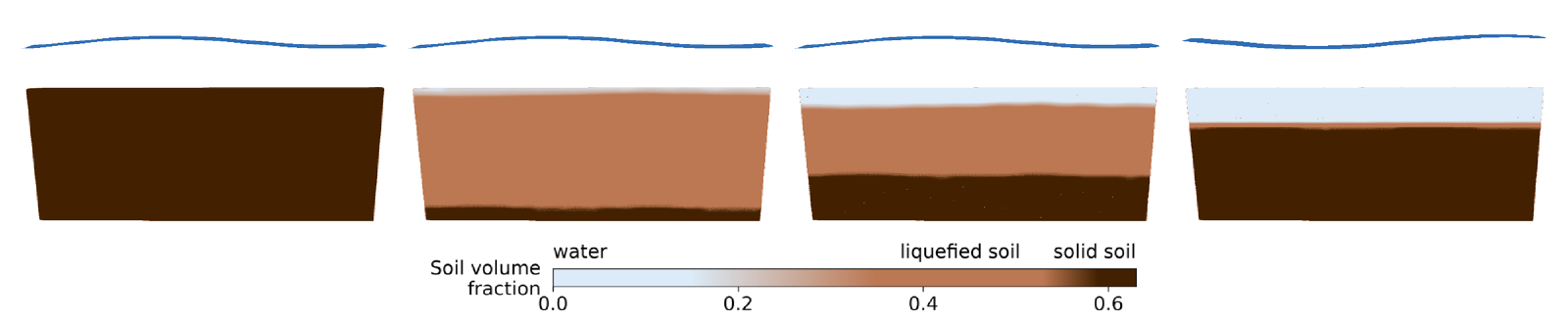
In the NuLIMAS project, Wikki developed an open-source numerical model in OpenFOAM® for seabed liquefaction around marine structures such as breakwaters, pipelines and the gravity anchors of floating offshore wind turbines.
Highlights
- One solver for all stages of liquefaction: pore-pressure build-up, the transition from solid to liquid, the flow and settling of the liquefied soil, and re-compaction to a solid bed.
- Needs few soil parameters, all of them easy to determine.
- Implemented in OpenFOAM® and published on GitHub.
- Validated against small-scale wave-flume experiments: the maximum pore pressure stays within 10 % of the measurements.
- Applied to a seabed loaded by a structure and by a cyclic mooring force.
The model
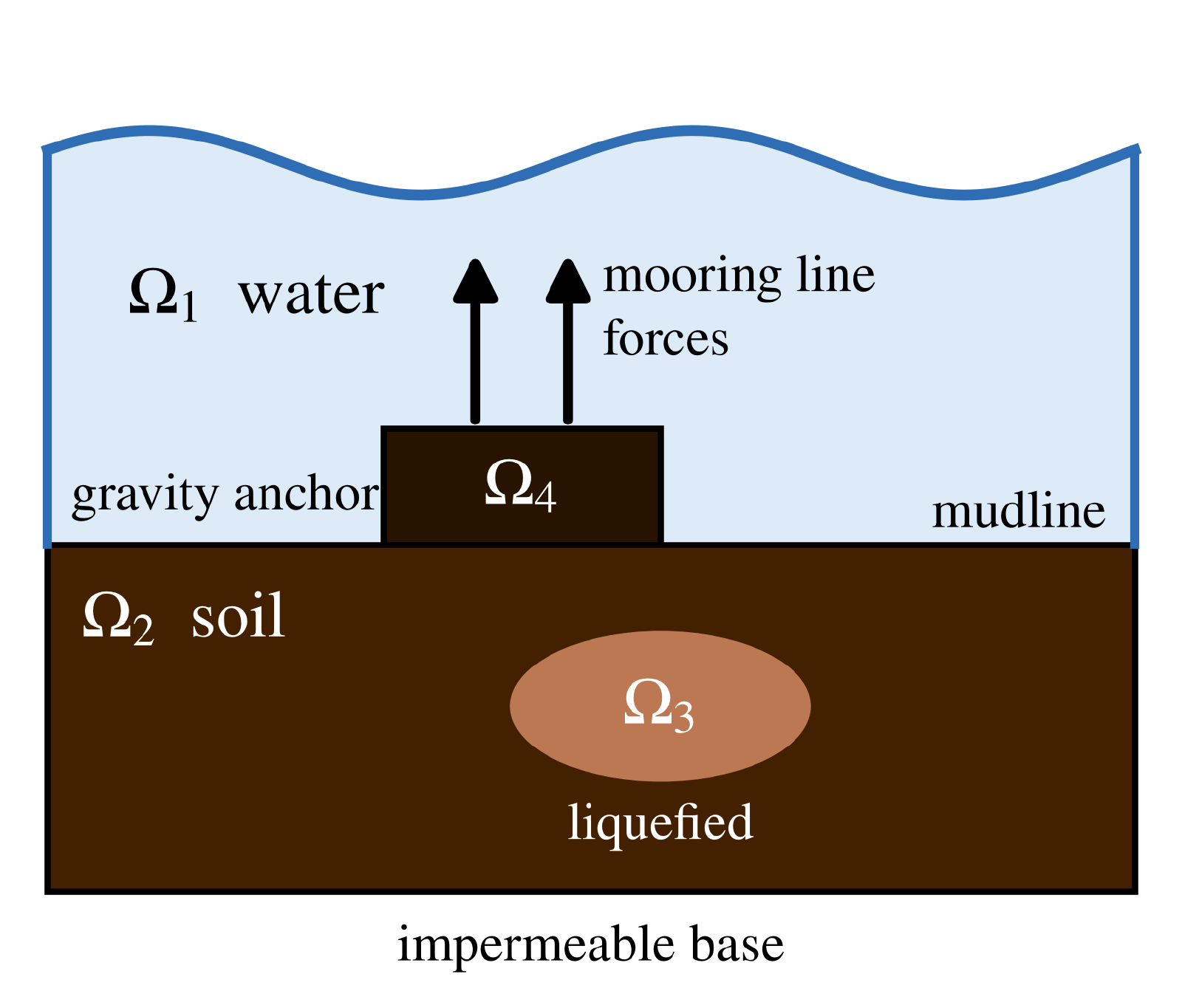
The model divides the domain into four regions and solves different equations in each. In the water (Ω₁), the waves act as a pressure on the mudline. The soil (Ω₂) is a poro-elastic solid of grains and pore water (Biot), in which the pore pressure builds up wave by wave. Liquefied soil (Ω₃) is a mixture of grains settling in water, described by a drift-flux model. The gravity anchor (Ω₄) is an elastic solid, with the mooring lines as a source of loading.
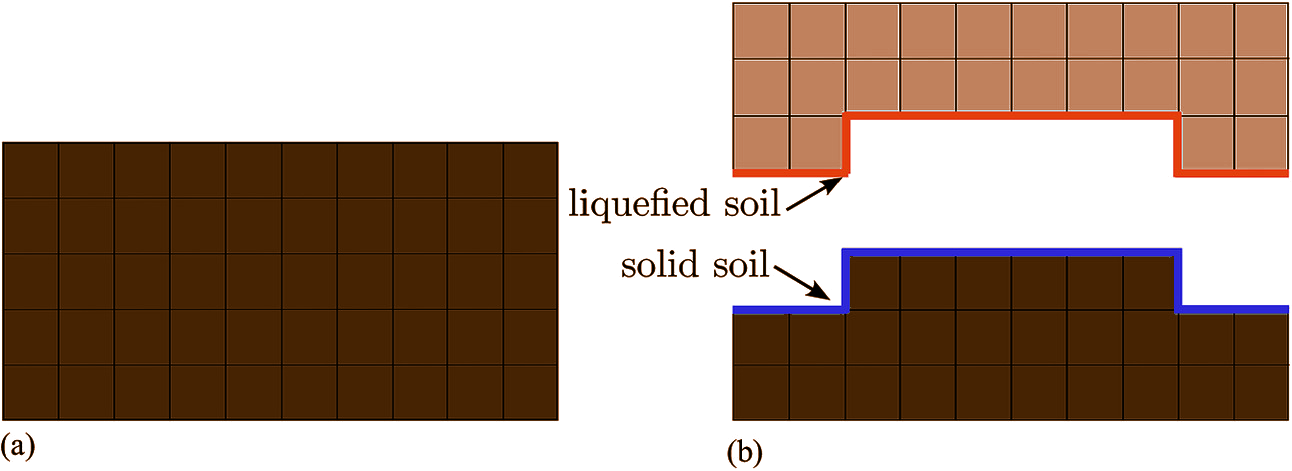
Every cell switches between the solid and the liquefied description as the soil liquefies and re-compacts. The boundary between the two zones is part of the mesh and moves with the liquefaction front.
Validation
The model was calibrated and validated with small-scale experiments at the Institute of Hydro-Engineering of the Polish Academy of Sciences (IBW PAN) in Gdańsk: a layer of loose soil on an impermeable base, 0.5 m water depth and four combinations of wave height and period.
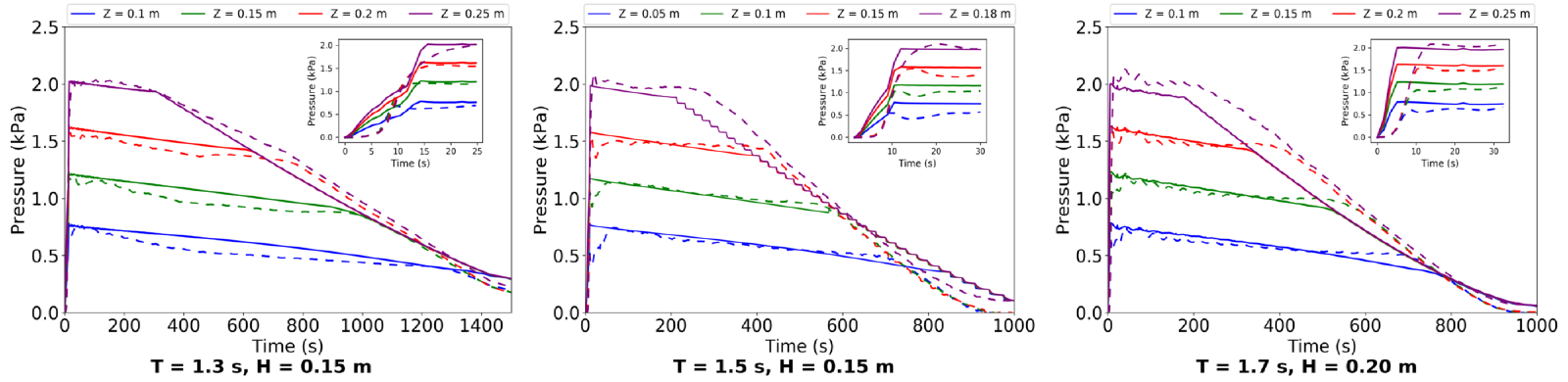
The computed pore pressure follows the measurements at all depths, through the build-up, the liquefied phase and the slow decay during compaction. The maximum pore pressure stays within 10 % of the measured values for all four wave cases.
Structures on the seabed
A structure on the seabed changes the effective stress in the soil beneath it, and with it where and how far the soil liquefies. The model resolves the structure together with the seabed. Under waves, the liquefied zone forms around and beneath the structure and grows down towards the impermeable base.

Depending on the weight of the structure and the forces acting on it, more or less pore pressure accumulates: a heavy structure restrains the rearrangement of the grains, while a lighter structure or a cyclic mooring force increases the pore pressure beneath it.
Open source and publications
The NuLIMAS toolbox and tutorials are available on GitHub.
Journal articles
- S. U. Yılmaz, V. S. Ö. Kirca, B. M. Sumer, R. K. Shanmugasundaram, H. Rusche, C. Windt, N. Goseberg: Liquefaction around a buried pipeline in a backfilled trench. Journal of Waterway, Port, Coastal, and Ocean Engineering 152(2), 04025038, 2026. doi:10.1061/JWPED5.WWENG-2313
- V. K. Vanjakula, R. K. Shanmugasundaram, C. Windt, F. Adam, H. Rusche, V. S. Ö. Kirca, N. Goseberg: Numerical investigation of wave-induced residual liquefaction: Model calibration and experimental validation. Journal of Waterway, Port, Coastal, and Ocean Engineering 152(1), 04025035, 2026. doi:10.1061/JWPED5.WWENG-2305
- R. K. Shanmugasundaram, H. Rusche, C. Windt, V. S. Ö. Kirca, B. M. Sumer, N. Goseberg: Numerical modeling of wave-induced seabed liquefaction: A drift-flux model for liquefied soil. Journal of Waterway, Port, Coastal, and Ocean Engineering 151(6), 04025028, 2025. doi:10.1061/JWPED5.WWENG-2276
- R. K. Shanmugasundaram, H. Rusche, C. Windt, V. S. Ö. Kirca, B. M. Sumer, N. Goseberg: Towards the numerical modelling of residual seabed liquefaction using OpenFOAM. OpenFOAM® Journal 2, 94–115, 2022. doi:10.51560/ofj.v2.56
Conference papers
- C. Windt, N. Goseberg, S. Schimmels, M. Kudella, R. K. Shanmugasundaram, H. Rusche, V. K. Vanjakula, F. Adam, D. Majewski, K. Kazimierowicz-Frankowska, M. Pietrzkiewicz, V. S. Ö. Kirca, B. M. Sumer: Liquefaction around marine structures: Development of a numerical modelling framework in OpenFOAM. ISOPE International Ocean and Polar Engineering Conference, 182–190, 2024.
- C. Windt, V. S. Ö. Kirca, B. M. Sumer, S. Schimmels, M. Kudella, H. Rusche, R. K. Shanmugasundaram, V. K. Vanjakula, F. Adam, D. Majewski, K. Kazimierowicz-Frankowska, M. Pietrzkiewicz, N. Goseberg: Severe seabed response around marine structures: Numerical modelling of seabed liquefaction. 11th International Conference on Scour and Erosion (ICSE-11), 2023.
- C. Windt, R. K. Shanmugasundaram, S. Schimmels, M. Kudella, H. Rusche, V. S. Ö. Kirca, B. M. Sumer, V. K. Vanjakula, F. Adam, D. Majewski, K. Kazimierowicz-Frankowska, M. Pietrzkiewicz, N. Goseberg: Numerical modelling of liquefaction around marine structures in the OpenFOAM framework. NUMGE 2023, ISSMGE, 2023. doi:10.53243/NUMGE2023-288
- C. Windt, N. Goseberg, S. Schimmels, M. Kudella, R. K. Shanmugasundaram, H. Rusche, V. K. Vanjakula, F. Adam, D. Majewski, K. Kazimierowicz-Frankowska, M. Pietrzkiewicz, V. S. Ö. Kirca, B. M. Sumer: Development of a numerical model for liquefaction around marine structures. ISOPE International Ocean and Polar Engineering Conference, ISOPE-I-23-179, 2023. doi:10.17736/ijope.2024.cl24
- C. Windt, N. Goseberg, S. Schimmels, M. Kudella, R. K. Shanmugasundaram, H. Rusche, B. M. Sumer, V. S. Ö. Kirca, V. K. Vanjakula, F. Adam et al.: Numerical modelling of liquefaction around marine structures – progress and recent developments. ASME OMAE 2022, V009T10A007, 2022.
- R. K. Shanmugasundaram, H. Rusche, C. Windt, V. S. Ö. Kirca, B. M. Sumer, N. Goseberg: Numerical modelling of residual liquefaction in the subsoil under a vibrating plate. ASME OMAE 2022, V009T10A006, 2022.
- V. S. Ö. Kirca, S. U. Yilmaz, B. M. Sumer, R. K. Shanmugasundaram, H. Rusche, C. Windt, N. Goseberg: Numerical modelling of wave-induced liquefaction around pipelines and offshore cables. ASME OMAE 2022, V009T10A005, 2022.
Funding
This work was supported by the three-year (2020–2023) research project NuLIMAS (Numerical Modelling of Wave-Induced Liquefaction Around Marine Structures) within the ERA-NET Cofund MarTERA Program under the EU Horizon 2020 Framework (Grant No. 728053), the German Federal Ministry for Economic Affairs and Climate Action (Grant No. 03SX524A–C) and the Scientific and Technological Research Council of Turkey (Grant No. TEYDEB-1509/9190068).